
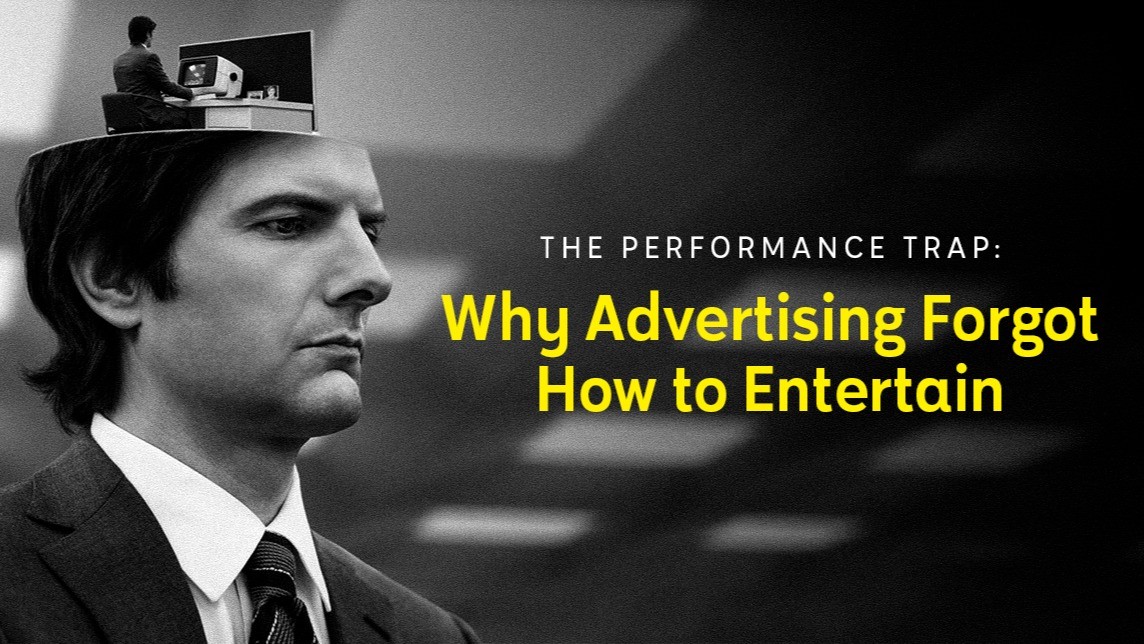
Advertising didn’t lose people’s attention; it stopped earning it. In the race to optimize conversion, brands forgot that emotion and entertainment are what make messages stick.
Brands are optimizing themselves into invisibility.
Brands are stuck in a performance trap. In chasing conversion, many advertisers forgot that real impact comes from earning attention by being worth watching.
Somewhere along the way, we decided that if something could be measured, it must be more important than whether it was memorable. Click-through rates replaced curiosity. Retargeting replaced storytelling. We became obsessed with what we could track and slowly lost sight of what people actually feel.
The real unfortunate part is that people didn’t stop wanting to be entertained. Many marketers just stopped prioritizing it.
We live in an attention economy, yet most advertisers behave as if attention is owed rather than earned. They interrupt instead of engage and then wonder why their messages vanish the moment a skip button appears.
The media didn’t reshape us. It just showed us who we are.
Let’s look at how people actually use media. We open Instagram for escapism. We scroll TikTok for entertainment. We binge Netflix for emotion and story.
These platforms didn’t rewire human behaviour; they revealed it. People don’t consume media to be persuaded; they go to be distracted, delighted, and emotionally stimulated. Advertising that understands this doesn’t feel like advertising. It feels like content.
That’s why TikTok positions itself as an entertainment company rather than a social platform. It reflects a deeper truth about attention: it isn’t transactional, it’s emotional. Instagram has undergone a similar shift. What began as a photo-sharing app is now a curated feed of aspiration, humour, beauty and escape. We’re not scrolling for product benefits. We’re scrolling for relief.
And yet, much of today’s advertising feels like it’s going against that instinct instead of working with it.
The biggest brands stopped acting like advertisers.
The brands earning attention today aren’t just selling products, they’re creating things people actually choose to watch. Instead of thinking like traditional advertisers, they’ve started thinking like publishers and studios, asking what kind of stories, worlds and experiences they can build rather than what messages they need to push.
Red Bull is a perfect example. It doesn’t just promote energy drinks, it produces documentaries, live events and full-scale sports films that feel more like entertainment than advertising. You see its’ values more than you see its’ logo. The brand is present, but the experience comes first.
Apple takes a similar approach, but in a slightly different way. Beyond producing award-winning original series through Apple TV, it also treats its advertising like cinema. Product launches are crafted with the pacing, storytelling and production value of short movies. In both cases, the goal isn’t immediate conversion; it’s to create cultural moments that stand on their own, earning attention first and trust over time.
That’s because these brands don’t treat conversion as the starting point of their creative process. They recognize that conversion is the result of something deeper: attention, interest and emotional connection built over time. Instead of asking how to shorten the path to purchase, they focus on making that path worth taking in the first place.
And that difference is everything.
They understand that attention isn’t something you capture at the bottom of the funnel, it’s something you earn long before someone ever clicks. Before people care, they have to feel something. And before they feel anything, you have to give them a reason to stop scrolling in the first place.
We buy emotionally and justify rationally.
The science backs this up. Research shows that humans make decisions emotionally and then justify them logically. We don’t choose brands with spreadsheets, we choose them with instinct, story and feeling. The rational brain may approve the purchase, but the emotional brain initiates it. And entertainment is one of the most reliable ways to activate that emotional response. When something makes us laugh, moves us or pulls us into a story, it lowers our resistance and increases our openness to remember and ultimately choose.
That’s why entertainment cues like the soundtrack are so powerful in advertising. A well-chosen piece of music can really create a feeling. A famous example comes from School of Rock, one of the rare films to feature a Led Zeppelin track. Jack Black personally pushed for it, explaining to the band why that song was essential to the spirit of the story. He knew the scene wouldn’t land the same way without it. And he was right. The track gave the moment its energy and credibility. It didn’t just support the scene; it defined it. That’s exactly what great advertising does: use entertainment to turn a message into a memory.
Great advertising uses entertainment to create emotional impact, and emotional impact drives memory. Memory influences behaviour, and behaviour is what performance marketing measures. In short, emotional resonance is what makes performance possible.
Knowing behaviour isn’t the same as inspiring it.
To be clear, this isn’t an argument against data. It’s an argument against letting data replace judgment.
Metrics are incredibly powerful when they’re used as feedback. They only become dangerous when they become the mission. When performance becomes the only goal, creative gets narrower, messaging gets shorter, and the story gets sacrificed.
We did the hard part as marketers… we learned how people behave. We learned where they click and when they drop off. But knowing behaviour isn’t the same as inspiring it.
This isn’t a call for brands to abandon performance marketing; it’s a call to rebalance it through more meaning per impression. Performance works best when it’s powered by creative that feels human, emotional, entertaining and culturally aware.